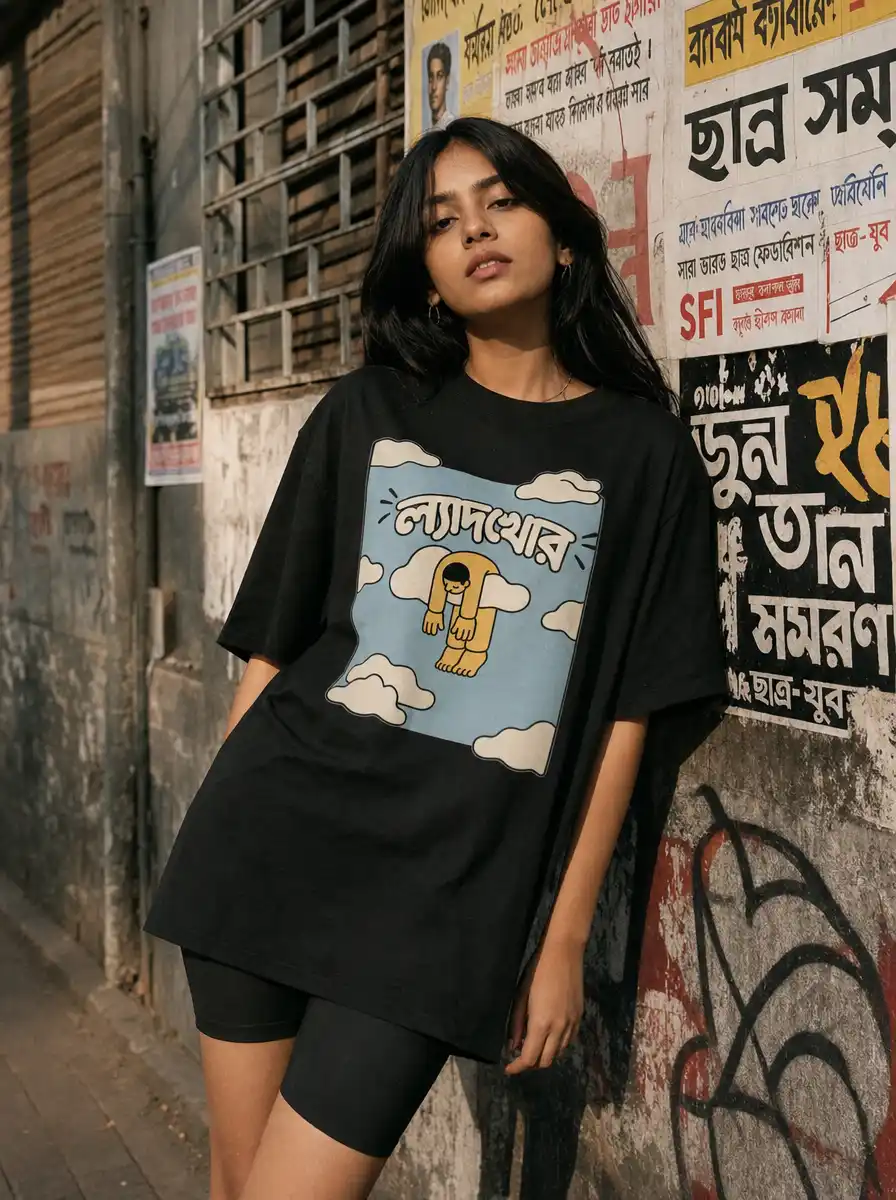
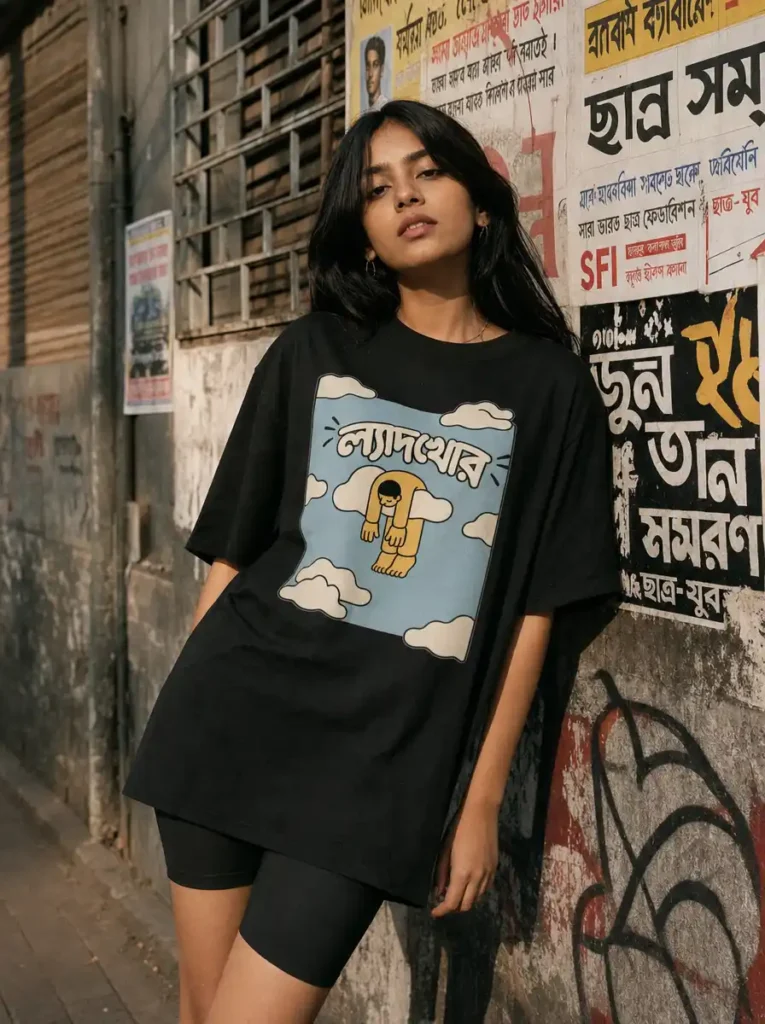
A Bengali slang t-shirt works on a principle English printing rarely manages: the word is funnier, warmer and more precise than any translation of it. Put one on cotton and half the street smiles before they have finished reading.
Here is why Bengali slang sits so well on clothing, and what the most-printed words actually carry.
Why Bengali Slang Beats English on a T-Shirt
English slogan tees have a problem — English is the language of instruction, offices and airports, so English on a shirt reads as neutral. It is understood everywhere and belongs nowhere.
Bengali is the opposite. It is the language of the house, the argument, the joke told at the third round of cha. A Bengali slang t-shirt sounds like a specific person from a specific place, which is exactly what a good graphic should do.
The Untranslatable Ones
These are the words that lose most in translation, which is precisely why they end up on shirts.
Adda — long, aimless, deeply enjoyable conversation. Not “chat”. Not “hanging out”. A cultural institution with no English equivalent.
Ghyama — showing off, with an edge of affectionate mockery.
Bhirmi khawa — to be so bewildered you go momentarily blank.
Ichhe — wish, want, urge. Softer and more wistful than any of those.
Jhogra — a proper argument, treated in Bengal as a legitimate pastime.
The Grammar of a Good Slang Tee
Not every funny phrase survives being printed. The ones that work tend to share three traits.
They are short — three or four words, readable across a room. They are self-contained, needing no setup to land. And they are generous: the joke includes the reader rather than mocking them. A line that makes the wearer look clever at someone else’s expense stops being fun very quickly.
Script Matters as Much as the Word
A Bengali phrase set in a badly stretched font undoes the whole idea. Bengali hangs from a top matra line rather than sitting on a baseline, and conjunct characters stack in ways Latin type never has to handle.
Set properly, the script is genuinely beautiful before it means anything — which is why we treat the letterforms as artwork rather than as a font choice.
Who Gets It, and Who Asks
The pleasure of wearing Bengali slang is watching the split-second sort it performs. Bengali readers react instantly. Everyone else asks what it means — and now there is a conversation, which was the point.
This works far outside Kolkata. A Bengali phrase in Bangalore, Delhi or Dubai finds its people quickly, and homesick Bengalis are the most reliable audience there is.
Wearing It Well
One slang piece per outfit. The tee is the loud element, so let everything else stay quiet — dark straight-fit jeans, clean footwear, no competing prints.
Fit matters too. Wordy graphics need flat space to read, so an oversized cut generally displays text better than a tight one.
A Note on Keeping It Readable
Text-heavy prints show wear faster than images because cracking breaks the letterforms and the joke dies with the legibility. Wash inside out, cold, and dry in shade — the full method is in our care guide.
Bengali is among the world’s most spoken languages, with well over 200 million speakers — a shirt in it is not niche, it is just specific.
Find Your Word
Browse the collection and find the phrase that already lives somewhere in your head. Tag #storyteller_india when you wear it — we repost our favourites on Instagram.