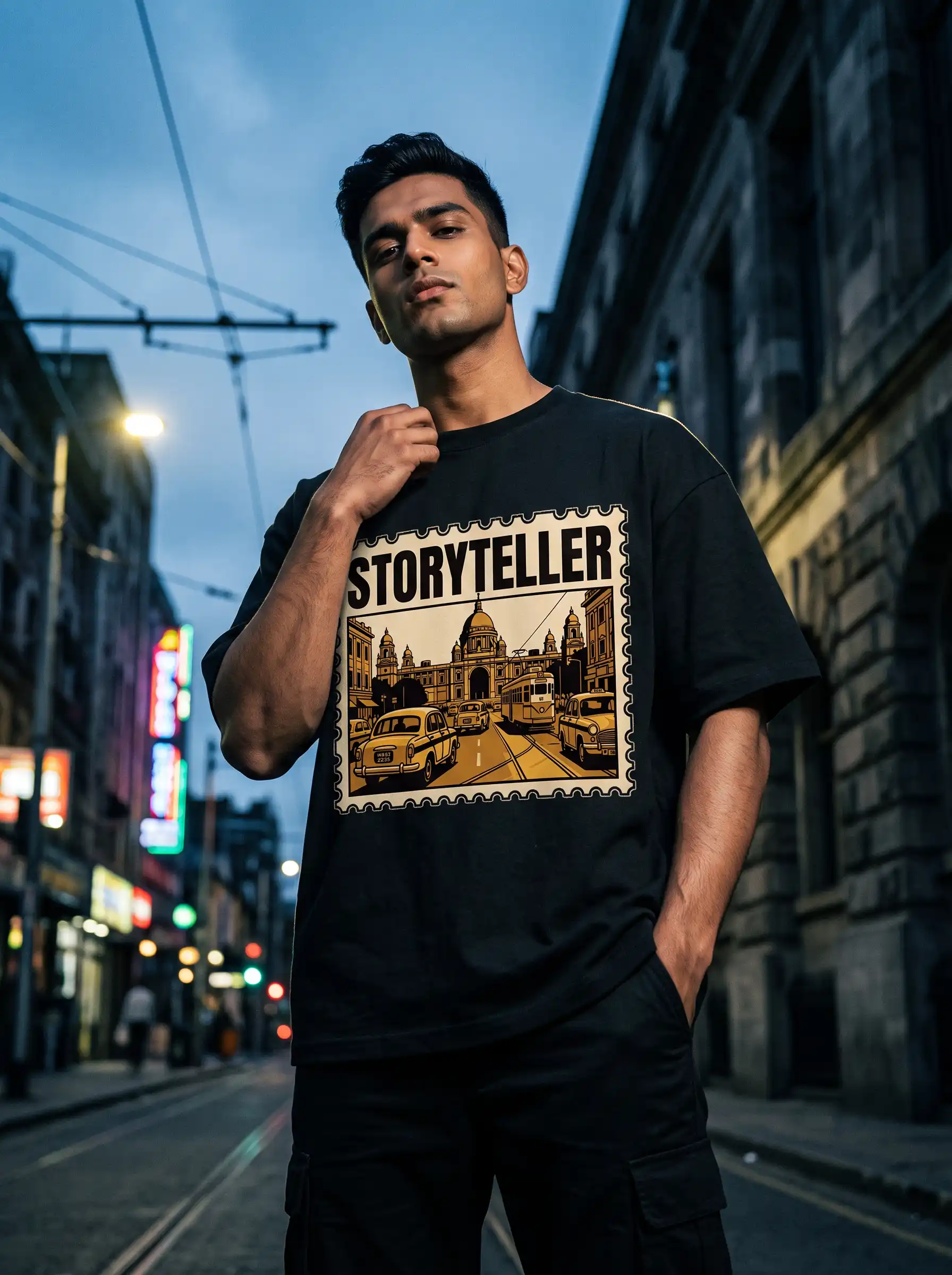
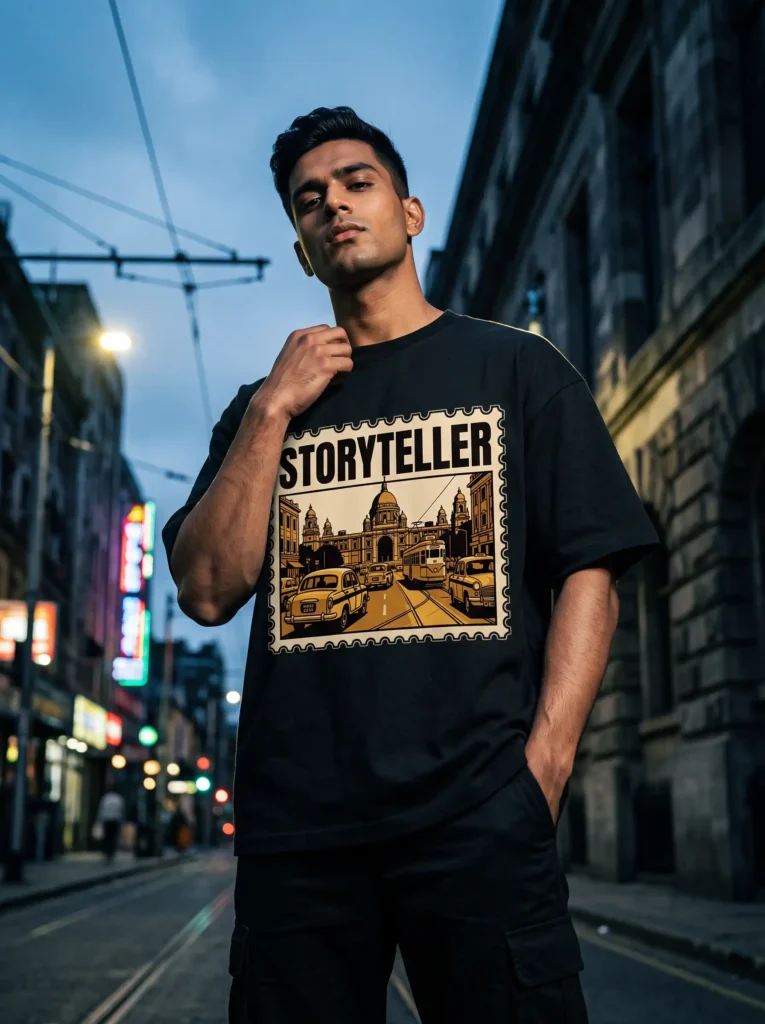
Search Kolkata street style and you get photo shoots — models in curated ethnic-fusion outfits posed against a colonial facade. Walk down Rashbehari Avenue on a Tuesday and you see something completely different, and far more useful.
This is a guide to what the city actually wears, and how to build the look without ending up in costume.
The Real Kolkata Street Style Formula
Strip it down and most well-dressed people here are running the same three-part formula: one strong top, one simple bottom, and footwear chosen for distance. Everything else is seasoning.
It is deliberately unfussy because the city demands it. You will walk further than you planned, the humidity will win by afternoon, and at some point you will sit down somewhere not entirely clean.
Tops: Where the Personality Goes
The graphic tee does the heavy lifting. A print with a Bengali phrase, a film reference or a piece of city iconography communicates faster than any styling trick.
Plain shirts appear for work and family occasions, but the everyday default is a tee with something on it. Pick one loud piece, not three — see our outfit combinations guide for pairings that hold up.
Bottoms: Boring on Purpose
Straight-fit jeans, relaxed trousers, or cargos. Dark and mid washes dominate because they hide splashback from puddles and survive multiple wears in humidity.
Shorts are common through peak summer but drop off sharply in more traditional neighbourhoods and at family events. Read the room.
Footwear: The Decision That Actually Matters
Kolkata pavements are uneven, frequently under repair, and under water for part of the year. This is not a city that rewards delicate shoes.
Sliders and sandals for daily heat, clean sneakers when you want to look put together, and something genuinely waterproof from June. Whatever you choose, assume you will walk several kilometres in it unplanned.
Colour: Why Everything Is Dark
Newcomers notice how much black, charcoal, olive and deep navy the city wears despite the heat. It is practical rather than aesthetic: dark fabric hides sweat marks, dust, rain splash and chai casualties.
Lighter colours do appear, mostly in the cooler weeks between December and February when the city briefly relaxes.
The Fabric Rule Nobody Breaks
Cotton, or something that behaves like it. Kolkata humidity regularly sits above seventy percent, and synthetic blends turn unbearable within an hour.
This is the one area where spending more is genuinely repaid — a heavier, properly finished cotton holds shape through repeated washing, which matters when you are washing things constantly. Our guide on made-in-India cotton covers why.
How the Look Shifts by Season
Summer (Mar–Jun): loosest fits of the year, lightest cotton, sandals, minimal layering.
Monsoon (Jun–Sep): dark colours, quick-dry fabric, waterproof footwear, always a spare layer in the bag.
Puja (Sep–Oct): the city’s dress-up peak. Comfort still wins because of the walking — see our Durga Puja outfit guide.
Winter (Dec–Feb): a genuine layering window. Overshirts, light jackets, and the only time boots make sense.
Three Mistakes Outsiders Make
Dressing the cliche. Full ethnic-fusion every day reads as costume. Locals wear ordinary clothes with one interesting element.
Ignoring the walking. Stylish, unbroken-in footwear ends badly here.
Too many references at once. One strong graphic beats a head-to-toe theme.
Start With One Good Tee
Kolkata street style is built around a single strong piece and a lot of restraint around it. Start there. Tag #storyteller_india when you wear yours and we will repost our favourites on Instagram.